When a company wins its first government contract, the excitement is real. So is the learning curve.
One of the first things we look at when a new government contractor comes to us is their chart of accounts. Not because it is the flashiest place to start, but because it tells us almost immediately whether their accounting system can actually support what a federal contract requires.
Most of the time, it cannot. And that is not a knock on the business. Commercial accounting systems are built for commercial work. Government contracting is a different environment with a different set of rules, and the chart of accounts is where that gap shows up first.
What DCAA Auditors Are Actually Looking At
The Defense Contract Audit Agency (DCAA) is there to protect the government’s interests. Auditors need to trace costs, verify they are allowable under federal regulations, and confirm they landed in the right place.
If your accounting system cannot produce that level of clarity, you have a structural problem. It may not surface as an audit finding on day one. But these things have a way of becoming audit findings later, usually at the worst possible time.
A DCAA compliant system needs to separate direct costs from indirect costs, track spending by contract, and generate reports that auditors can actually follow without needing a guide. The chart of accounts is what makes all of that possible or impossible.
Direct and Indirect Costs Are Not the Same Thing
This is where most first-time government contractors run into real trouble. In commercial accounting, the line between direct and indirect costs is often blurry, and that is fine. In government contracting, that line has to be clear, documented, and applied consistently.
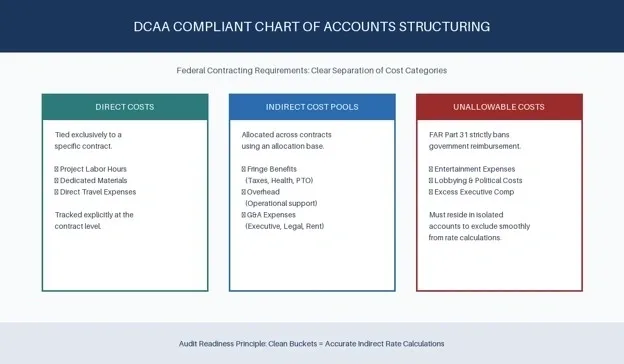
Direct costs are costs that tie specifically to a contract, such as:
• Labor hours worked on a project
• Materials purchased specifically for that project
• Travel directly related to contract performance
These need to be tracked explicitly at the contract level.
Indirect costs are everything else like rent, utilities, administrative salaries, and fringe benefits. These get accumulated into indirect cost pools and then allocated across contracts using an allocation base. If your chart of accounts does not organize expenses to reflect that structure, you cannot produce the cost reports the government expects. That is not a minor gap.
Indirect Cost Pools Matter More Than Most People Realize
Most government contractors need to accumulate specific categories of indirect costs into distinct pools. Each pool uses an allocation base, usually direct labor dollars or hours, to spread those costs across contracts. The ratio that results is your indirect cost rate.
To ensure maximum transparency for DCAA auditors, a compliant structure typically requires at least two and often three essential indirect cost pools:
• Fringe Benefits: Accumulates personnel-related costs like payroll taxes, health insurance, paid time off, and retirement benefits.
• Overhead: Accumulates costs that support direct operations but are not tied to a single contract, such as technical supervision, facility costs for operational teams, or specialized tools.
• General and Administrative (G&A): Accumulates the overall management and business-running expenses, including executive salaries, legal fees, accounting, and corporate rent.
DCAA looks at these rates carefully. They want to see that the pools are set up consistently, that costs are going into the right buckets, and that the allocation methodology makes sense for the type of work being performed. Without the right account structure, you cannot calculate your indirect rates correctly, creating a compliance problem that compounds over time.
The Account Structure Problems We See Most Often
Expense accounts that are too broad are the most common issue we encounter. A single account labeled salaries tells you nothing about whether those wages were direct labor on a contract or indirect administrative time. DCAA needs both, tracked separately.
We also see companies mixing allowable and unallowable costs in the same accounts. Federal Acquisition Regulation (FAR) Part 31 defines which costs the government will and will not reimburse. When unallowable costs are buried inside accounts with allowable costs, your indirect rate calculations are wrong before you even start.
To maintain compliance, unallowable costs must have their own designated accounts so they can be cleanly excluded when calculating your rates. Key examples of strictly unallowable costs include:
• Entertainment and amusement expenses
• Certain lobbying and political expenditures
• Executive compensation that exceeds established federal threshold limits
The Right Time to Fix This Is Before You Start
The clients who have the smoothest experience with DCAA are almost always the ones who got the accounting structure right before they started performing on a contract. Once costs start accumulating in the wrong places, untangling them takes significantly more time and effort.
If you have already started work and are not confident your chart of accounts is set up correctly, that is still fixable. But it is better to address it now than to wait for an auditor to surface it.
We work with government contractors to set this up correctly from the beginning and to work through remediation when the structure needs to be rebuilt. If you have questions about where your accounting system stands heading into a federal contract, we are glad to take a look.