We work with a lot of SaaS founders in the lead-up to their Series A. And while every company is different, the financial mistakes we see are remarkably consistent.
None of them are the result of bad intentions. They usually come from founders who were heads-down building product and just never had the bandwidth to get the financial infrastructure right. The problem is that by the time a raise is on the table, those issues are hard to clean up quickly.
These are the five we see most often.
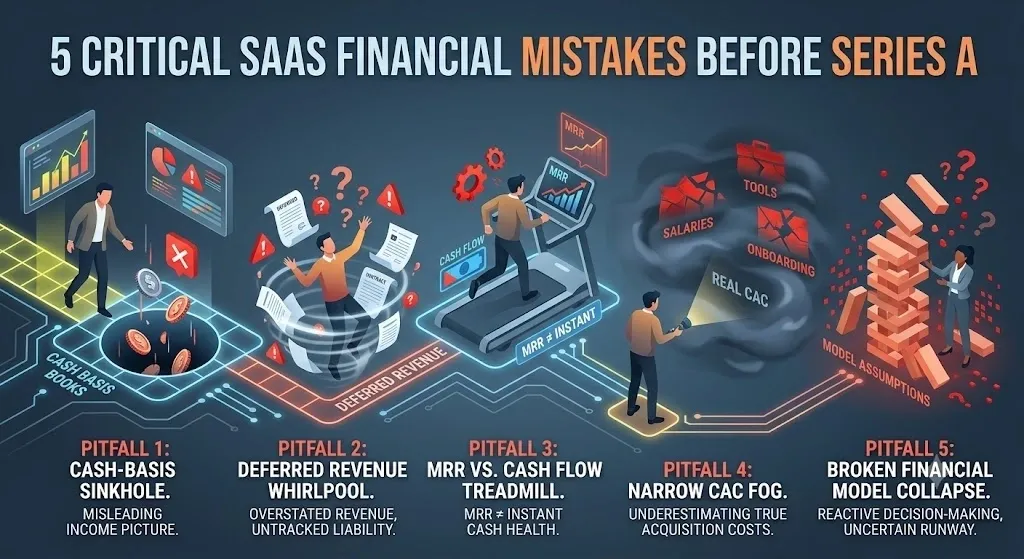
1. Still Running on Cash Basis Books
Cash basis accounting makes sense when you are just getting started. It is simple and it keeps things moving. But once you are signing annual contracts and collecting subscription revenue upfront, it starts giving you a very misleading picture of the business.
We have seen founders close a strong month of new contracts, feel great about where things stand, and then be caught off guard when cash gets tight two months later. Cash basis books do not show you that the revenue you collected in January actually belongs to the next 12 months. That matters a lot when you are trying to understand what you are really earning versus what just hit your bank account.
Investors expect accrual basis financials at Series A. If you have not made that switch yet, do it before diligence starts. Restating books under a deadline is a stressful process that slows everything down.
2. Deferred Revenue Is Not on Anyone’s Radar
This one is connected to the first, but it is worth calling out on its own because we see it missed even in companies that think their books are clean.
When a customer pays upfront for a year of service, that money is a liability until you actually deliver the service. It goes on the balance sheet as deferred revenue, not directly to the income statement. A lot of early-stage SaaS companies skip this step entirely, which means their revenue figures are overstated and their balance sheet does not reflect what they actually owe customers going forward.
During diligence, investors look at deferred revenue closely. If it has not been tracked properly, the conversation shifts from growth potential to financial credibility. That is not where you want to be when you are trying to close a round.
3. Treating MRR and Cash Flow as the Same Thing
Monthly Recurring Revenue is a great metric. It tells you a lot about the trajectory of the business. What it does not tell you is whether you have enough cash to make payroll next month.
We talk to founders regularly who are genuinely confused about why their bank account feels tight when MRR is growing. The answer is usually some combination of high acquisition costs, a hiring pace that got ahead of collections, or platform and infrastructure spend that scaled faster than revenue. MRR going up does not automatically mean cash is healthy.
Tracking both, and understanding the relationship between them, is one of the more important financial disciplines a SaaS founder can build. It changes how you think about hiring decisions, spending, and when to start a fundraising process.
4. CAC Is Being Calculated Too Narrowly
When we ask founders what it costs them to acquire a customer, most of them quote their ad spend. Sometimes they include sales commissions. Very few are accounting for the full picture.
Customer acquisition cost should include everything that touches the sales and marketing process: salaries, tools, events, onboarding labor, management overhead. When you add all of that in, the number usually looks quite different from what founders expect. And the LTV to CAC ratio they thought was healthy often needs to be reconsidered.
Series A investors will pressure test this. Founders who know their real CAC, and can speak to how they plan to bring it down over time, tend to have much more productive conversations than founders who are working from an incomplete number.
5. No Financial Model to Speak Of
We are not talking about a 40-tab spreadsheet. A financial model does not have to be complicated. But it does need to exist, and it needs to reflect how the business actually works.
Without one, financial decisions tend to be reactive. Founders hire when things feel good and pull back when things feel uncertain, but without a model tying those decisions to revenue projections and cash runway, it is hard to know whether you are making the right call or just responding to the moment.
A good model forces you to articulate your assumptions, which is exactly what investors are going to ask you to do anyway. Founders who come into a Series A conversation already knowing their unit economics, their growth assumptions, and their cash needs by quarter are simply easier to back.
A Note From Our Team
We have seen companies walk into a raise with strong revenue and a compelling product, and still struggle because the financial foundation was not there. It is one of the more frustrating situations to be in because the business is genuinely good.
Getting this stuff right is not about impressing investors. It is about having accurate information to run the business well. The fundraising benefits are real, but they are really just a byproduct of having clean books and solid financial processes in place before you need them.
If you are approaching Series A and have questions about where your financials stand, we are happy to take a look. That is exactly the kind of work we do with our clients.