Revenue forecasting sounds straightforward until you are the one responsible for it.
We have worked with enough RevOps and finance teams to know that most forecasting problems are not about effort. People are working hard. The issues tend to be structural; things baked into how the process was set up that nobody has stopped to question. And because the forecast is wrong in the same direction every quarter, leadership just starts mentally adjusting for it rather than fixing the root cause.
That is not a great place to be.
Here is what really gets in the way of an accurate revenue forecast:
Pipeline and Forecast Are Not the Same Number
This is probably the most common one. Teams pull their total pipeline, apply a percentage, and call it a forecast. It feels methodical. It is not really forecasting.
Pipeline tells you what is possible. A forecast requires judgment about what is truly going to close, and when. A deal that has been sitting in stage three for ninety days and a deal that just came in hot from a referral should not be weighed the same way. But in many systems, they are.
The percentage applied to pipeline usually comes from a historical average that may not reflect what is happening right now with this specific set of deals and this specific team. It smooths over the details that do matter.
The CRM Data Problem Nobody Wants to Talk About
Forecasting processes are only as good as the data underneath them. And in a lot of companies, that data is not in great shape.
Close dates get pushed without any notes. Deal stages do not reflect where things actually stand. Some reps are diligent about updating records and others are not. When we audit CRM data with clients, the inconsistencies are always worse than leadership realizes.
You cannot build a reliable forecast on top of unreliable inputs. Before redesigning a forecasting model, the more important question is whether the underlying data can trusted. That conversation is uncomfortable but necessary.
RevOps and Finance Are Running Separate Numbers
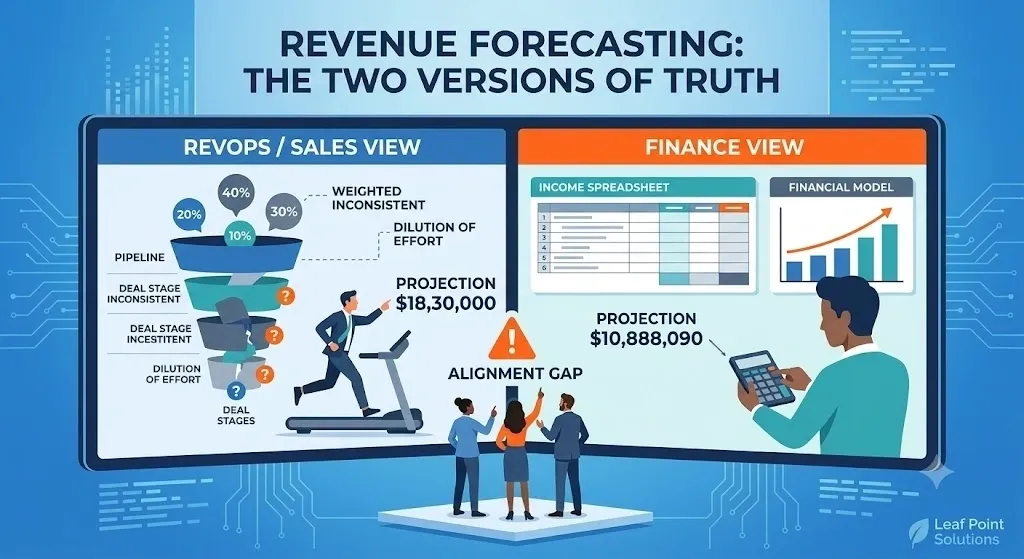
This one causes real problems and often does not surface until the worst possible moment, like a board meeting or a planning cycle where both teams present different revenue projections and nobody can explain the gap.
RevOps forecasting that lives in a sales tool and never connects to the financial model is only doing half its job. Finance needs to be working from the same assumptions, using the same revenue definitions, and agreeing on the same timing. When that alignment does not exist, decisions get made on two different versions of the truth.
Getting RevOps and finance in the same room to agree on how revenue is defined and when it counts sounds basic. It is surprising how rarely this happens.
Historical Win Rates Are Sitting There Unused
Most companies have years of data on what has truly closed versus what was forecasted. A lot of them are not using it.
Win rates look quite different when you break them down by deal size, segment, rep, and channel. A single blended conversion rate applied to all deals hides those differences and produces a forecast that is wrong in ways that are hard to diagnose.
The data to do this better already exists in most cases. It just requires someone to go pull it and actually build it into the forecasting assumptions. That step tends to get deprioritized because the team is focused on closing the quarter rather than improving the system that forecasts it.
The Forecast Gets Built Once and Then Ignored
A forecast that gets updated once at the start of the quarter is not really a forecast. It is a starting point.
By week six of a quarter, so much has changed. Deals that looked solid have gone quiet. A few things have accelerated unexpectedly. If the forecast has not been updated to reflect any of that, leadership is making decisions based on a snapshot that no longer represents reality.
Weekly forecast reviews feel like a lot of overhead until you have been in a situation where you missed a quarter that a current forecast would have flagged early. The teams that build that cadence into their process tend to have fewer surprises, and when surprises do happen, they have more time to respond.
Getting the Forecast Right Is Worth the Work
When forecasting is working the way, it should, it is not just a number leadership reports out. It is a tool they use to make decisions about hiring, spending, and when to push harder or pull back.
Most of the fixes are not complicated. Cleaner CRM data, tighter alignment between RevOps and finance, win rates that reflect actual history, and a consistent review cadence. The work is in building those habits and making sure they stick.
If your forecasts have been consistently off and the team cannot quite explain why, that gap is worth digging into. It usually points to one of the issues above, and finding it tends to be faster than most teams expect.