If you have been hearing the term Revenue Operations, or RevOps, more frequently in business conversations, you are not imagining it. RevOps has quickly become one of the most talked-about functions in growing organizations, particularly in SaaS, technology, and professional services companies. But what exactly is Revenue Operations, why does it matter, and how do you know if your business needs it? This guide breaks it all down in plain language.
After working with growing organizations across more than 30 industries, one of the most common things we hear from founders and executives is that they cannot trust their own numbers. Sales says one thing, finance says another, and marketing has a third version of the truth. In our experience, that is almost never a bookkeeping problem. It is a Revenue Operations problem.
What Is Revenue Operations?
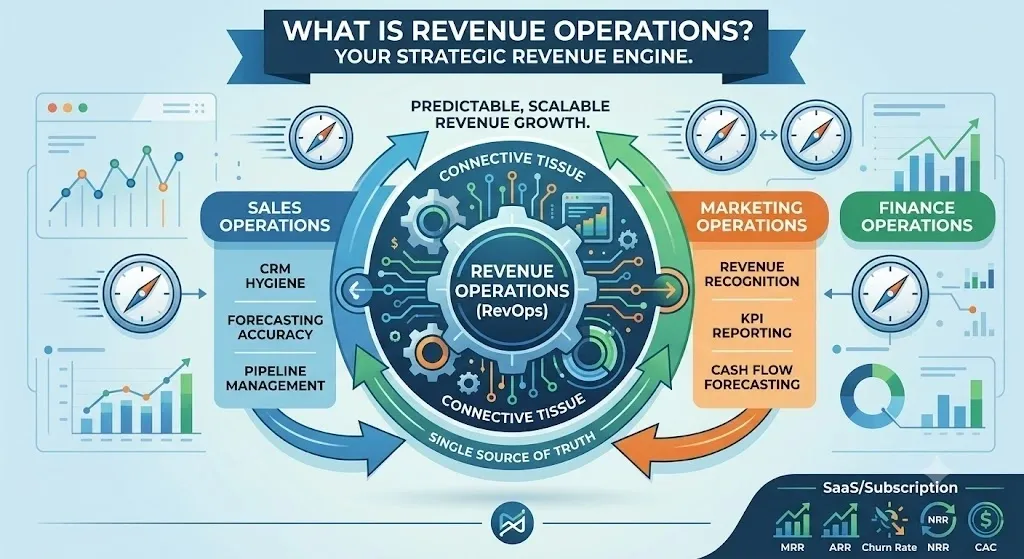
Revenue Operations, commonly referred to as RevOps, is the strategic alignment of your sales, marketing, and finance functions around a single goal: predictable, scalable revenue growth. Rather than allowing these three departments to operate in silos with separate tools, separate data, and separate priorities, RevOps brings them together under a unified operational framework.
Think of RevOps as the connective tissue of your revenue engine. It ensures that everyone responsible for generating and retaining revenue is working from the same data, using compatible systems, and moving in the same direction. When RevOps is functioning well, your sales team knows which leads are most likely to convert, your marketing team understands which campaigns are driving real revenue, and your finance team can forecast accurately because the underlying data is clean and consistent.
RevOps is not a single role or a single tool. It is a discipline that combines people, processes, data, and technology to create a more efficient and predictable revenue organization.
The Three Pillars of Revenue Operations
RevOps typically sits at the intersection of three core functions:
Sales Operations
Managing the sales pipeline, CRM hygiene, quota setting, commission calculations, and forecasting accuracy so the revenue team can focus on selling rather than administration.
Marketing Operations
Ensuring that lead generation, campaign tracking, attribution reporting, and marketing technology are producing reliable data that connects marketing activity to actual revenue outcomes.
Finance Operations
Providing the financial backbone through revenue recognition, KPI reporting, budget-to-actual analysis, cash flow forecasting, and executive dashboards that translate operational activity into financial intelligence.
When these three functions are connected and coordinated through RevOps, businesses gain a complete picture of their revenue cycle from the first marketing touchpoint all the way through to collected cash and recognized revenue.
The biggest mistake we see organizations make is treating finance as an afterthought in the revenue conversation. Finance gets brought in at month-end to reconcile what already happened, rather than being part of the team shaping what happens next. RevOps fixes that by putting financial intelligence at the center of every revenue decision.
Why Revenue Operations Matters for Growing Businesses
Organizations that implement RevOps consistently report meaningful improvements across several key areas:
• Better forecasting accuracy because sales, marketing, and finance are working from a single source of truth rather than three separate spreadsheets
• Faster revenue growth because bottlenecks and inefficiencies in the revenue process are identified and eliminated more quickly
• Improved customer retention because handoffs between departments are smoother and customer data is more complete
• Stronger financial reporting because finance has direct visibility into pipeline and revenue data rather than waiting for month-end summaries
• More confident decision-making at the executive level because leadership has real-time KPI dashboards rather than lagging reports
For SaaS and subscription businesses in particular, RevOps is especially critical. Metrics like Monthly Recurring Revenue (MRR), Annual Recurring Revenue (ARR), churn rate, Net Revenue Retention (NRR), and Customer Acquisition Cost (CAC) only tell a complete story when sales, marketing, and finance data are integrated. Without RevOps, these metrics are often calculated differently by different teams, leading to conflicting reports and unreliable forecasts.
5 Signs Your Business May Need Revenue Operations
1. Your sales, marketing, and finance teams report different revenue numbers
If each department has its own version of the truth, you have a data alignment problem that RevOps can solve.
2. Your forecasts are consistently inaccurate
When pipeline data, marketing attribution, and financial projections are disconnected, forecasting becomes guesswork.
3. Your CRM is messy or underutilized
A neglected CRM is one of the most common symptoms of an organization that needs RevOps discipline. In our experience working with growing companies, this is the sign we encounter most frequently — and it is almost always fixable with the right process and the right data discipline.
4. You are scaling but your revenue processes are not keeping up
Growth exposes gaps in process. RevOps creates the infrastructure that allows revenue to scale without constant firefighting.
5. Your leadership team does not have real-time visibility into revenue performance
If your executives are waiting for monthly reports to understand how the business is performing, RevOps can change that.
How a Fractional Controller Supports Revenue Operations
Many growing businesses do not need a full-time RevOps team. What they need is someone who understands both the financial side and the operational side of revenue, can build the right reporting frameworks, and can help leadership make sense of their data. This is where a fractional Controller with Revenue Operations expertise can make an immediate impact.
We worked with a growing SaaS client whose sales team and finance team were producing completely different ARR numbers every month. Sales was pulling from the CRM, finance was pulling from the billing system, and neither matched. Leadership had lost confidence in both numbers and was making growth decisions based on gut feel rather than data. Within 60 days we reconciled both systems, established a single source of truth, built a monthly revenue dashboard, and gave the executive team a number they could actually trust. That kind of clarity changes how a business operates.
A fractional RevOps and Controller engagement typically includes:
• Building and maintaining KPI dashboards that give leadership real-time visibility into revenue, pipeline, and financial performance
• Designing revenue forecasting models that connect sales pipeline data to financial projections
• Standardizing how revenue metrics like MRR, ARR, churn, and NRR are calculated and reported across departments
• Setting up commission calculation processes and quota management frameworks
• Integrating financial data with CRM and marketing platforms to create a unified revenue view
• Identifying process inefficiencies that are slowing down the revenue cycle
The advantage of a fractional model is that you get senior-level Revenue Operations expertise without the cost of a full-time hire. For most growing businesses, 10 to 20 hours per month of focused RevOps support can produce measurable improvements in forecasting accuracy, reporting visibility, and revenue process efficiency.
Frequently Asked Questions About Revenue Operations
Is Revenue Operations only for large companies?
No. RevOps principles apply to any organization that has sales, marketing, and finance functions operating together. In fact, early-stage and growth-stage companies often benefit the most from RevOps because it helps them build scalable revenue infrastructure before bad habits become entrenched.
Do I need a dedicated RevOps team?
Not necessarily. Many businesses start with a fractional RevOps resource who can assess the current state, build the right frameworks, and implement the systems and processes needed. As the business grows, a dedicated function can be built out over time.
How is RevOps different from sales operations?
Sales operations focuses specifically on the sales function. Revenue Operations takes a broader view, connecting sales, marketing, and finance so that all three departments are aligned around the same revenue goals and working from the same data.
What tools are commonly used in RevOps?
Common RevOps tools include CRM platforms like HubSpot and Salesforce, financial systems like QuickBooks Online and NetSuite, data warehouses like Snowflake, and reporting tools like Tableau, Power BI, and custom dashboards. The right tech stack depends on the size and complexity of your organization.
How do I know if my RevOps efforts are working?
Key indicators include improved forecast accuracy, reduced time to close financial reporting, cleaner CRM data, fewer discrepancies between sales and finance numbers, and leadership having greater confidence in the revenue data they are using to make decisions.
Ready to Bring Revenue Operations to Your Business?
Revenue Operations is not just a buzzword. It is a practical discipline that helps growing businesses generate more predictable revenue, make better decisions, and scale more efficiently. Whether you are a SaaS founder trying to make sense of your metrics, a nonprofit leader seeking better financial visibility, or a business owner whose sales and finance teams seem to always be working from different numbers, RevOps can help.
What we enjoy most about Revenue Operations work is the moment a leadership team stops guessing and starts deciding. When the dashboards are built, the data is clean, and the numbers finally tell a consistent story, the energy in the room changes. Executives stop debating which number is right and start asking what to do about it. That shift is what we work toward with every client.
At Leaf Point Solutions, we provide fractional Controller and Revenue Operations support to growing organizations across the United States. We help you build the KPI frameworks, dashboards, forecasting models, and financial processes that give your leadership team the clarity and confidence to make smart revenue decisions.
Contact us today to schedule a free consultation and learn how Revenue Operations can transform your business.
www.leafpointsolutions.com